sales@naturalin.com
 +86(731)84430651








Is consuming blueberry powder regularly truly beneficial for eye health?
Author : Naturalin Date : Click : times
In today's digital age, our eyes are constantly bombarded by blue light from smartphones, computers, and other electronic devices. Coupled with long hours of close-range work and irregular living habits, eye fatigue, dryness, and blurred vision have become common problems affecting people of all ages. Against this backdrop, blueberry powder, as a concentrated form of natural blueberry extract, has gained widespread attention for its purported eye-protective effects. But the question remains: Is consuming blueberry powder regularly truly beneficial for eye health? The answer is a resounding Yes. Backed by scientific research and practical applications, regular intake of blueberry powder can provide targeted protection for eye health through multiple mechanisms.
The eye-protective efficacy of blueberry powder stems from its rich array of bioactive components, with anthocyanins being the most critical. Unlike fresh blueberries, high-quality blueberry powder (especially those produced via low-temperature freeze-drying technology) retains over 90% of the active ingredients in blueberries, making it a more efficient way to supplement these nutrients .
Anthocyanins, a class of water-soluble natural pigments that give blueberries their deep purple color, possess three key eye-protective mechanisms. Firstly, they can penetrate the blood-retinal barrier, directly acting on retinal tissue to promote the regeneration of rhodopsin. Rhodopsin is a photosensitive substance in the rod cells of the retina that is responsible for vision in low-light environments. Prolonged eye use accelerates the consumption of rhodopsin, leading to poor dark adaptation and night blindness. Clinical data shows that continuous intake of blueberry extract for 4 weeks can improve night vision sensitivity by 30% . Secondly, anthocyanins exhibit powerful antioxidant activity—20 times that of vitamin C—which enables them to effectively scavenge free radicals generated in the eyes due to long-term exposure to blue light and oxygen. This reduces oxidative damage to retinal cells, especially the macula, which is crucial for fine vision . Thirdly, anthocyanins can relax the microvessels in the eyes, improve retinal blood circulation, and ensure an adequate supply of nutrients and oxygen to the eyeball, thereby alleviating eye fatigue and soreness caused by poor circulation .
In addition to anthocyanins, blueberry powder also contains vitamin A, lutein, and zeaxanthin, which work synergistically to enhance eye protection. Vitamin A maintains the health of the ocular surface (such as the conjunctiva and cornea) and prevents dry eyes and night blindness. Lutein and zeaxanthin act as "natural filters" in the macula of the retina, absorbing harmful blue light and reducing the risk of macular degeneration . Studies have shown that combining blueberry anthocyanins with lutein can enhance the eye-protective effect by 1.8 times compared to using a single component .
1. Relieves eye fatigue and improves dry eye symptoms
For office workers, students, programmers, and other groups who engage in long-term close-range work or use electronic devices, eye fatigue (characterized by dryness, soreness, and blurred vision) is a daily annoyance. A 12-week randomized, double-blind, placebo-controlled clinical trial found that daily intake of blueberry extract significantly improved the ciliary muscle tension caused by prolonged screen use, and the subjective eye fatigue score of the subjects decreased significantly . Moreover, anthocyanins in blueberry powder can increase tear secretion, maintain the stability of the tear film, and effectively alleviate dry eye symptoms. In a study on dry eye patients, 80% of the subjects showed improved ocular surface moisture after 6 weeks of taking blueberry extract .
2. Protects the retina and reduces the risk of age-related eye diseases
The retina is the core of the eye's photosensitive function, and the macula is responsible for central vision. With age or long-term blue light exposure, the retina is prone to degenerative damage, leading to diseases such as age-related macular degeneration (AMD), which is a major cause of vision loss in the elderly. A long-term study involving 36,653 middle-aged and elderly women found that compared with those who did not consume blueberries, women who consumed ≥2 servings of blueberries per week had a 64% lower risk of developing total AMD (hazard ratio = 0.36, 95% confidence interval: 0.14-0.93) . This confirms that regular intake of blueberry-related products can effectively protect the retina and reduce the risk of age-related eye diseases.
3. Improves dark adaptation and night vision
Good night vision relies on the rapid regeneration of rhodopsin. As mentioned earlier, anthocyanins in blueberry powder can significantly promote the synthesis of rhodopsin. A study by the University of Tsukuba in Japan found that continuous intake of blueberry extract can significantly improve night contrast sensitivity, enabling people to adapt more quickly to dim environments (such as driving at night or looking at objects after turning off the lights) and reducing the feeling of "night blindness" . For people who need to work or move in low-light environments for a long time, regular consumption of blueberry powder is particularly beneficial.
4. Aids in myopia prevention and control in adolescents
The rising myopia rate among adolescents has become a public health concern. In addition to poor eye habits, insufficient nutritional support is also a hidden factor contributing to vision loss. Animal experiments have shown that oral administration of blueberry extract can inhibit the axial elongation of myopia in guinea pigs, thereby preventing the progression of myopia . For adolescents in the critical period of eye development, supplementing with blueberry powder can provide antioxidant protection for the eyes and support healthy eye tissue development, which is a positive supplement to myopia prevention and control .
References
1.The Blueberry Council. Intake of Blueberries, Anthocyanins, and Risk of Eye Disease in Women. 2025.
2.PMC. Therapeutic Effects of Anthocyanins for Vision and Eye Health. 2025.
3.PMC. A 12-Week-Long Intake of Bilberry Extract (Vaccinium myrtillus L.) Improved Objective Findings of Ciliary Muscle Contraction of the Eye: A Randomized, Double-Blind, Placebo-Controlled, Parallel-Group Comparison Trial.
4.MDPI. Extract from Aronia melanocarpa, Lonicera caerulea, and Vaccinium myrtillus Improves near Visual Acuity in People with Presbyopia. 2024.
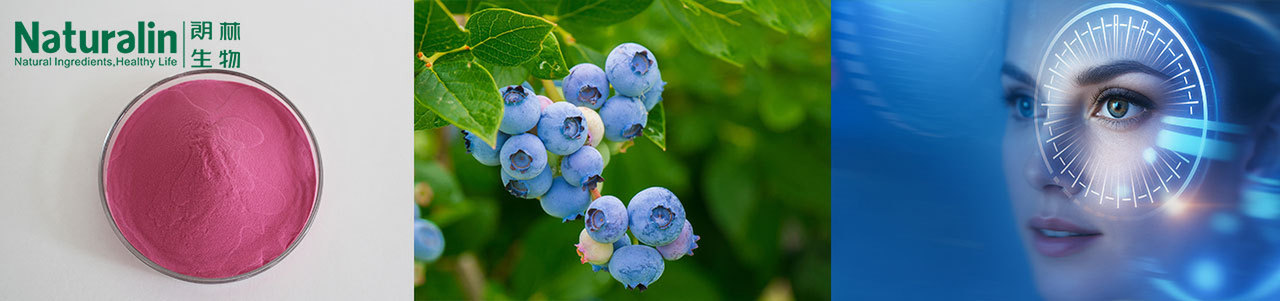
The Core Eye-Protective Components in Blueberry Powder and Their Mechanisms of Action
The eye-protective efficacy of blueberry powder stems from its rich array of bioactive components, with anthocyanins being the most critical. Unlike fresh blueberries, high-quality blueberry powder (especially those produced via low-temperature freeze-drying technology) retains over 90% of the active ingredients in blueberries, making it a more efficient way to supplement these nutrients .
Anthocyanins, a class of water-soluble natural pigments that give blueberries their deep purple color, possess three key eye-protective mechanisms. Firstly, they can penetrate the blood-retinal barrier, directly acting on retinal tissue to promote the regeneration of rhodopsin. Rhodopsin is a photosensitive substance in the rod cells of the retina that is responsible for vision in low-light environments. Prolonged eye use accelerates the consumption of rhodopsin, leading to poor dark adaptation and night blindness. Clinical data shows that continuous intake of blueberry extract for 4 weeks can improve night vision sensitivity by 30% . Secondly, anthocyanins exhibit powerful antioxidant activity—20 times that of vitamin C—which enables them to effectively scavenge free radicals generated in the eyes due to long-term exposure to blue light and oxygen. This reduces oxidative damage to retinal cells, especially the macula, which is crucial for fine vision . Thirdly, anthocyanins can relax the microvessels in the eyes, improve retinal blood circulation, and ensure an adequate supply of nutrients and oxygen to the eyeball, thereby alleviating eye fatigue and soreness caused by poor circulation .
In addition to anthocyanins, blueberry powder also contains vitamin A, lutein, and zeaxanthin, which work synergistically to enhance eye protection. Vitamin A maintains the health of the ocular surface (such as the conjunctiva and cornea) and prevents dry eyes and night blindness. Lutein and zeaxanthin act as "natural filters" in the macula of the retina, absorbing harmful blue light and reducing the risk of macular degeneration . Studies have shown that combining blueberry anthocyanins with lutein can enhance the eye-protective effect by 1.8 times compared to using a single component .
Specific Eye-Protective Benefits of Regular Blueberry Powder Consumption
1. Relieves eye fatigue and improves dry eye symptoms
For office workers, students, programmers, and other groups who engage in long-term close-range work or use electronic devices, eye fatigue (characterized by dryness, soreness, and blurred vision) is a daily annoyance. A 12-week randomized, double-blind, placebo-controlled clinical trial found that daily intake of blueberry extract significantly improved the ciliary muscle tension caused by prolonged screen use, and the subjective eye fatigue score of the subjects decreased significantly . Moreover, anthocyanins in blueberry powder can increase tear secretion, maintain the stability of the tear film, and effectively alleviate dry eye symptoms. In a study on dry eye patients, 80% of the subjects showed improved ocular surface moisture after 6 weeks of taking blueberry extract .
2. Protects the retina and reduces the risk of age-related eye diseases
The retina is the core of the eye's photosensitive function, and the macula is responsible for central vision. With age or long-term blue light exposure, the retina is prone to degenerative damage, leading to diseases such as age-related macular degeneration (AMD), which is a major cause of vision loss in the elderly. A long-term study involving 36,653 middle-aged and elderly women found that compared with those who did not consume blueberries, women who consumed ≥2 servings of blueberries per week had a 64% lower risk of developing total AMD (hazard ratio = 0.36, 95% confidence interval: 0.14-0.93) . This confirms that regular intake of blueberry-related products can effectively protect the retina and reduce the risk of age-related eye diseases.
3. Improves dark adaptation and night vision
Good night vision relies on the rapid regeneration of rhodopsin. As mentioned earlier, anthocyanins in blueberry powder can significantly promote the synthesis of rhodopsin. A study by the University of Tsukuba in Japan found that continuous intake of blueberry extract can significantly improve night contrast sensitivity, enabling people to adapt more quickly to dim environments (such as driving at night or looking at objects after turning off the lights) and reducing the feeling of "night blindness" . For people who need to work or move in low-light environments for a long time, regular consumption of blueberry powder is particularly beneficial.
4. Aids in myopia prevention and control in adolescents
The rising myopia rate among adolescents has become a public health concern. In addition to poor eye habits, insufficient nutritional support is also a hidden factor contributing to vision loss. Animal experiments have shown that oral administration of blueberry extract can inhibit the axial elongation of myopia in guinea pigs, thereby preventing the progression of myopia . For adolescents in the critical period of eye development, supplementing with blueberry powder can provide antioxidant protection for the eyes and support healthy eye tissue development, which is a positive supplement to myopia prevention and control .
Conclusion
About Naturalin
References
1.The Blueberry Council. Intake of Blueberries, Anthocyanins, and Risk of Eye Disease in Women. 2025.
2.PMC. Therapeutic Effects of Anthocyanins for Vision and Eye Health. 2025.
3.PMC. A 12-Week-Long Intake of Bilberry Extract (Vaccinium myrtillus L.) Improved Objective Findings of Ciliary Muscle Contraction of the Eye: A Randomized, Double-Blind, Placebo-Controlled, Parallel-Group Comparison Trial.
4.MDPI. Extract from Aronia melanocarpa, Lonicera caerulea, and Vaccinium myrtillus Improves near Visual Acuity in People with Presbyopia. 2024.
Label:
- Next Page:Chaga Mushroom Extract in Mushroom Coffee
-
 Return list
- Previous Page:How do plant extracts promote eye health?