sales@naturalin.com
 +86(731)84430651




How to Distinguish Between Anthocyanidins and Proanthocyanidins?
Author : Naturalin Date : Click : times
Anthocyanidins and proanthocyanidins, with only one character difference in their Chinese names, are often confused by consumers, industry practitioners, and even researchers. In fields such as health products, food additives, and skincare products, both are highly sought-after natural active ingredients, gaining widespread attention for their excellent biological effects. However, they are not the same substance and exhibit significant differences in chemical nature, physical properties, existence forms, and efficacy intensity. This article will conduct an in-depth analysis of the differences and connections between the two from multiple dimensions, helping readers fully clarify their understanding and better grasp their application value.
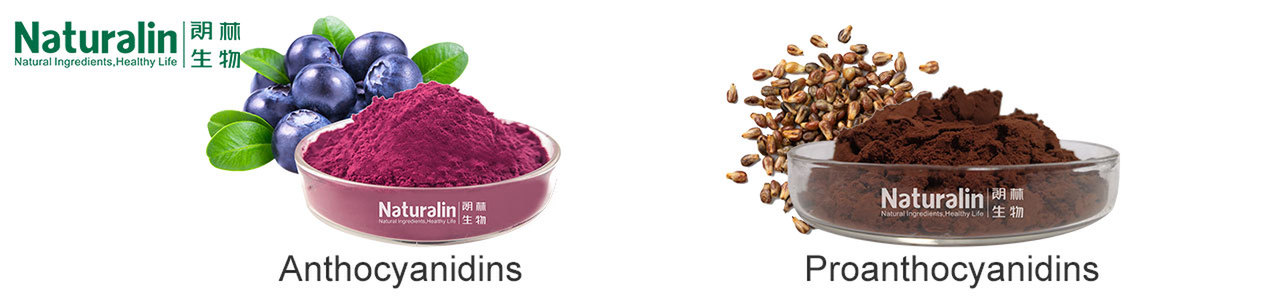
Anthocyanidins: The "Natural Colorists" of the Plant Kingdom
Anthocyanidins are a class of natural water-soluble pigments widely distributed in the plant kingdom, belonging to the flavonoid compound family. They are also the core pigments that give color to plant tissues such as petals, fruits, and stems. Their most prominent characteristic is that their color dynamically changes with the pH environment of the cell sap: when the cell sap is acidic, the molecular structure of anthocyanidins changes, presenting a bright red or pink color; when the cell sap is alkaline, it turns blue, purple, or blue-purple; in a neutral environment, it mostly appears purple. This unique color-regulating ability allows plants in nature to display a colorful array of hues. For example, the deep purple of blueberries, the bright red of cherries, and the blue-purple of morning glories all rely on anthocyanidins.
As water-soluble pigments, anthocyanidins are easily soluble in polar solvents such as water and ethanol. In plant tissues, they mainly exist in glycosylated forms (i.e., anthocyanins), a structural feature that not only enhances their stability but also makes them more easily absorbed and utilized by the human body. In plants, besides imparting color, anthocyanidins also perform important physiological functions, such as protecting plant cells from UV damage, attracting insects for pollination, and resisting pathogen invasion.
Proanthocyanidins: The "Precursor Reserve Army" of Anthocyanidins
Proanthocyanidins are oligomers or polymers formed by connecting different numbers of catechin or epicatechin molecules through carbon-carbon bonds, belonging to polyphenolic compounds. Their name is closely related to their chemical transformation characteristics: during metabolic processes in plants, proanthocyanidins can be converted into anthocyanidins through degradation, oxidation, and other reactions, hence they are called "precursor substances of anthocyanidins."
Unlike anthocyanidins, proanthocyanidins themselves are colorless, a property that allows them to accumulate in large quantities in non-colorful parts of plants such as skins, shells, and seeds without affecting the plant's appearance. During food processing or extraction, under conditions such as high temperature and pH changes, proanthocyanidins undergo hydrolysis reactions and gradually convert into colored anthocyanidins. This is why raw materials rich in proanthocyanidins, such as grape seeds and pine bark, exhibit a faint purple-red color after processing. Proanthocyanidins vary greatly in degree of polymerization: oligomers (usually referring to dimers to pentamers) have better water solubility and bioavailability, while polymers are more difficult for the human body to absorb but still possess certain physiological activities.
Efficacy and Effects: Overlaps and Differences Coexist
As natural active ingredients, both anthocyanidins and proanthocyanidins possess a variety of health benefits for the human body, with core effects focusing on antioxidant, anti-inflammatory, and free radical scavenging activities. However, due to differences in molecular structure and activity intensity, there are also certain distinctions in their efficacy performance.
• Antioxidant and Free Radical Scavenging: Both are potent antioxidants that can capture and eliminate excess free radicals in the body, reducing oxidative damage to cellular DNA, proteins, and lipids, thereby delaying the aging process and lowering the risk of chronic diseases. Free radicals are important contributors to various issues such as skin aging, cardiovascular diseases, and tumors, and the antioxidant effects of anthocyanidins and proanthocyanidins can effectively neutralize this harm.
• Anti-Inflammatory Effects: Both can inhibit the release of inflammatory factors in the body (such as TNF-α, IL-6) , reduce inflammatory responses, and have a certain relieving effect on chronic inflammation such as arthritis, gastroenteritis, and skin inflammation.
• Skin Protection: Through antioxidant and anti-inflammatory effects, both can reduce damage to the skin caused by UV radiation and environmental pollution, delay the formation of skin wrinkles, improve skin elasticity, and inhibit melanin deposition, exerting a certain whitening and spot-lightening effect.
2.Efficacy Differences: The "Unique Advantages" of Proanthocyanidins
In terms of overall efficacy intensity and specificity, proanthocyanidins perform more prominently, especially with unique advantages in the following aspects:
• Stronger Antioxidant Capacity: The antioxidant activity of proanthocyanidins is much higher than that of anthocyanidins, and their free radical scavenging capacity is 20 times that of vitamin C and 50 times that of vitamin E. This is attributed to the fact that their polymer structure contains more phenolic hydroxyl groups, which can bind to free radicals more efficiently and inactivate them.
• Vision Protection Efficacy: Proanthocyanidins have unique vision protection effects, which is a core advantage not possessed by anthocyanidins. They can penetrate the blood-retinal barrier, scavenge free radicals in retinal cells, reduce retinal damage caused by blue light, improve ocular blood circulation, relieve symptoms such as eye fatigue and dryness, and play a positive role in preventing myopia progression and age-related macular degeneration.
• Stronger Vascular Protection Effects: Proanthocyanidins can enhance the elasticity and toughness of blood vessel walls, reduce vascular fragility, and decrease capillary leakage, which is helpful for improving issues such as varicose veins and edema. In addition, their effect of inhibiting platelet aggregation is more significant, which can further reduce the risk of thrombosis.
Application Fields: Each Excelling in Its Own Way, Widely Empowering
1. Food Industry: Natural Pigments and Functional Additives
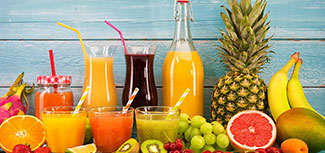
• Applications of Anthocyanidins: With their natural coloring ability and good water solubility, anthocyanidins are often used as natural food pigments, widely applied in products such as fruit juices, jams, beverages, candies, and pastries, replacing synthetic pigments. They not only meet the color requirements of products but also add health attributes. For example, the natural purple color of blueberry juice and purple sweet potato beverages, and the red color of cherry candies can all be achieved by adding anthocyanidins. In addition, anthocyanidins can also be added as functional ingredients to health foods to exert antioxidant and cardiovascular protective effects.
• Applications of Proanthocyanidins: Being colorless themselves, proanthocyanidins are more suitable for use as functional additives in various foods without affecting the original color of the products. For example, adding proanthocyanidins to edible oils, dairy products, and meat products can exert their antioxidant effects and extend the shelf life of products; adding them to meal replacement powders and cereal products can enhance the health benefits of products, meeting consumers' needs for antioxidant and eye protection. Grape seed extract (rich in proanthocyanidins) is one of the commonly used functional raw materials in the food industry.
2. Health Product Industry: Targeted Health Solutions
• Anthocyanidin-Based Health Products: Mostly using blueberry extract, purple cabbage extract, mulberry extract, etc., as raw materials, their main efficacy focuses on antioxidant, beauty and skin care, and cardiovascular protection, suitable for people pursuing skin care and concerned about cardiovascular health. Product forms are mostly capsules, tablets, oral liquids, etc., which are convenient to take.
3. Cosmetics Industry: Natural Skincare Active Ingredients
• Applications of Anthocyanidins: Anthocyanidins have antioxidant, anti-inflammatory, and melanin-inhibiting effects, and are often added to skincare products to improve skin dullness, lighten spots, and soothe sensitive skin. For example, adding anthocyanidins to toners, serums, and masks can help the skin resist free radical damage, enhance the skin barrier function, and make the skin appear bright and glowing. Their natural coloring properties also make them suitable for use as natural pigments in some color cosmetics (such as lip gloss and blush).
• Applications of Proanthocyanidins: The potent antioxidant and vascular protection effects of proanthocyanidins make them highly favored in anti-aging skincare products. They can penetrate deep into the skin's bottom layer, scavenge free radicals, delay collagen loss, and reduce wrinkle formation; at the same time, they improve skin blood circulation and relieve issues such as facial edema and red blood streaks. In addition, the anti-inflammatory effect of proanthocyanidins also has a certain soothing effect on acne-prone skin and sensitive skin, and they are often added to serums, creams, eye creams, and other products, especially suitable for mature skin and skin exposed to UV radiation for a long time.
Conclusion
Contact Naturalin
References
1. Prior, R. L., Wu, X., & Schaich, K. (2005). Polyphenolic antioxidants from fruits. Current Opinion in Food Science, 4(3), 234-242.
2. Rice-Evans, C. A., Miller, N. J., & Paganga, G. (1996). Structure-antioxidant activity relationships of flavonoids and phenolic acids. Free Radical Biology and Medicine, 20(7), 933-956.
3. Santos-Buelga, C., & Scalbert, A. (2000). Proanthocyanidins and tannin-like compounds – nature, occurrence, dietary intake and effects on nutrition and health. Journal of the Science of Food and Agriculture, 80(7), 1094-1117.
4. Tsuda, T. (2012). Anthocyanidin metabolism and its effects on physiological functions. Journal of Nutritional Science and Vitaminology, 58(1), 1-8.
5. Gu, L., Kelm, M. A., Hammerstone, J. F., Beecher, G., Holden, J., Haytowitz, D., & Prior, R. L. (2004). Concentrations of anthocyanins in common foods in the United States and estimation of normal consumption. Journal of Agricultural and Food Chemistry, 52(13), 4033-4042.
6. Bagchi, D., Bagchi, M., Singh, A., & Kale, A. (2000). Free radicals and grape seed proanthocyanidin extract: importance in human health and disease prevention. Toxicology Letters, 114(1), 187-197.
 Return list